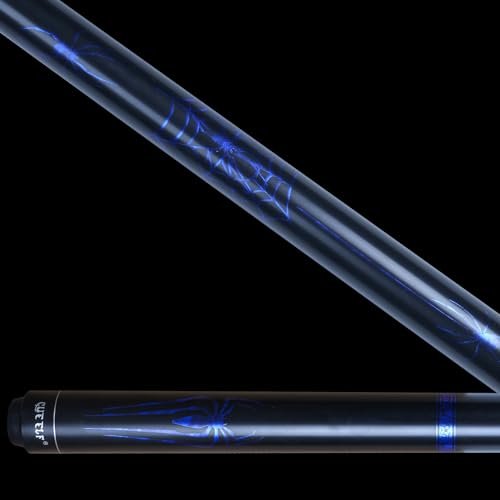
CUEELF holds a 92.5% positive review rate across 161 verified Alibaba listings — a number that holds up alongside the brand's Amazon ratings, which average 4.4 stars across all 11 products in the lineup.
Every CUEELF playing cue starts with Canadian Hard Rock Maple that's dried and cured to minimize warpage — not a marketing phrase, but a process decision you'll notice when the shaft holds its straightness through a full season of weekly league nights.
Playing cue, break cue, chalk, chalk holder, and tip repair tool — CUEELF makes every piece of the kit, and each product is designed to work alongside the others rather than as an afterthought accessory thrown in to round out a catalog.
CUEELF backs its products against manufacturing defects — if a joint fails under normal play or a tip separates from the ferrule out of the box, that's a warranty situation; the policy is clear, the claim process runs through Amazon, and there are no hoops beyond what you'd expect from a legitimate manufacturer.
Every category in the CUEELF lineup connects to the next — you buy the playing cue, realize your main shaft shouldn't take break-shot abuse, add the Heavy Hitter, chalk both tips differently, and clip the holder to your belt between shots. The pool cue, break jump cue, billiard chalk, billiard chalk holder, and cue tip repair tool lines are designed to form a complete working kit rather than five unrelated products that happen to share a logo.
Four models built on Canadian Hard Rock Maple — from the 4.7-star Spider with its low-deflection shaft and carbon fiber extension to the Scorpion's titanium joint and Irish linen wrap, for players who want real spec decisions at a non-custom price.
The CUEELF Heavy Hitter line gives league players a genuine break/jump solution in one 3-piece stick — Bakelite tip, Hard Maple shaft, and a quick-release joint that converts between configurations in seconds. ```
CUEELF billiard chalk comes in five colors — including grey and green for players who are done with blue dust on their bridge hand — and is formulated to stay on the tip between shots rather than spray off on contact. ```
The CUEELF Magnetic Chalk Holder keeps your chalk exactly where you need it — clipped to your belt, magnetically secured, and ready before every shot. Here's everything a league player needs to know before buying. ```
The CUEELF 5-in-1 tip repair cube handles every routine tip-maintenance task — shaping, scuffing, aerating, burnishing, and pick insertion — in a stainless steel tool that fits in a chalk pocket. Here's what it does, who it's for, and how to use it right. ```
Browse the complete brand catalog with up-to-date pricing on Amazon.
These are the CUEELF products league players and serious recreational shooters reach for most — not because they're the cheapest options in each category, but because the spec decisions at each price point hold up under the kind of scrutiny that comes from people who've been burned by budget gear before.
The CUEELF pool cue line covers four distinct models on a foundation of 100% Canadian Hard Rock Maple — each shaft cured to resist warpage and built around a phenolic ferrule and 6-layered tip system that delivers consistent feedback on every stroke. The Spider leads the lineup at 4.7 stars across 111 reviews, with a low-deflection shaft, 13mm tip, and a 20cm carbon fiber extension included. The Scorpion comes in black and white with a 12.5mm tip and titanium alloy joint — a narrower feel for players who prefer a tighter contact point. The Pink Maple Cue rounds out the line with a full accessory bundle and 19.5–21 oz weight range, built for players who want a complete setup without piecing one together.
The right CUEELF cue depends on three things: whether you play with heavy English (where low deflection matters most), whether you prefer a wrapped or wrapless grip, and what accessories you need out of the box. The Spider is the place to start for most players upgrading from a house stick — but it's not the right call for everyone.
The Spider Low-Deflection Cue with Case carries CUEELF's highest rating across the entire catalog: 4.7 out of 5 stars across 111 reviews. That number matters because it's earned on a technically demanding product — a low-deflection shaft built from 100% Canadian Hard Rock Maple, a 13mm 6-layered black tip with phenolic ferrule, and a 3/8×8 joint that locks up tight enough to behave like a solid one-piece cue on the stroke. The wrapless design is intentional: no linen, no texture, just direct hand-to-maple contact that gives you clean tactile feedback on every shot.
The Spider also includes the most complete accessory package in the cue lineup — a 1×1 hard case, a 20cm carbon fiber extension, joint protectors, and a replacement tip. For a player who's tired of buying a cue and then realizing they need to source a case separately, that matters. It's available in 20 oz only, which suits most intermediate players with a controlled stroke. If you regularly load up running English or need to play precise position, the low-deflection shaft is where that investment pays back.
The Scorpion runs in two colorways — White (4.6★, 98 reviews) and Black (4.5★, 68 reviews) — and both use the same core build: 12.5mm 6-layered tip, phenolic ferrule, titanium alloy joint, and black Irish linen wrap. That 0.5mm difference in tip diameter compared to the Spider is real and noticeable. A narrower tip gives you a slightly crisper hit feel on center-ball shots and naturally suits players who don't rely heavily on extreme side spin. The titanium joint is stiff and vibration-free — some players actually prefer the feedback it transmits over the Scorpion's nearest competitors at this price tier.
The Irish linen wrap is the other genuine differentiator. Players who sweat through their grip hand, who play long sessions, or who just don't like the feel of bare wood on a stroke will find the linen wrap more reliable. It's not a compromise — it's a legitimate preference. The Scorpion Black includes a hard case and replacement tip in the box, which gives it a bundle edge over the White variant (joint protectors only). Weight options run 19.5, 20, and 21 oz across both.
The Pink Maple Cue with Case (4.5★, 70 reviews) shares more DNA with the Spider than it looks like at first glance — same 13mm 6-layered tip, same stainless steel 3/8×8 joint, same wrapless Canadian maple build. The differences are cosmetic: the pink printing process, pink grip detailing, and pink 1×1 case. Available in 19.5 to 21 oz.
This is the right choice for a gift buyer who wants a real cue — not a house-cue-level stick wrapped in pink — or for a newer player who wants a personal cue that performs at the same specification level as the Spider without the low-deflection tech price bump. If you're buying this for yourself because you like the look, that's a completely legitimate reason. The construction holds up.
| If you... | Choose |
|---|---|
| Play heavy English and want maximum cue ball accuracy | Spider Low-Deflection Cue with Case |
| Prefer a linen wrap and a slightly narrower tip feel | Scorpion Cue White Titanium Joint or Scorpion Cue Black with Hard Case |
| Want the Scorpion with a full bundle (case included) | Scorpion Cue Black with Hard Case |
| Buying as a gift or want a first personal cue with a complete kit | Pink Maple Cue with Case |
One honest note on all four cues: Hard Rock Canadian Maple will warp if you leave it in a car trunk in summer heat or lean it in a corner. Store every cue vertically in the included case, keep it out of humidity extremes, and it'll hold its straightness through years of league play. That's not a CUEELF-specific caveat — it applies to every maple cue at every price point.
Every product in the CUEELF lineup connects to something else. The playing cue determines what chalk you prioritize; the break cue changes how you apply that chalk; the tip tool's function set depends on which tip material you're maintaining; and the chalk holder is the piece that makes all of it accessible during a game without fumbling through your bag. Here's how they fit together — and which combination makes sense for each type of player.
The playing cue is the anchor of the kit. If you're upgrading from a house cue or a budget starter cue and you rely on English for position play, begin with the Spider Low-Deflection Cue with Case. The low-deflection shaft keeps the cue ball tracking closer to your aim line when you load up side spin — that's the function of the 3/8×8 joint, the Canadian maple curing process, and the shaft taper working together, not marketing language. It comes with the hard case, extension, and replacement tip already in the box, so the first chapter of your kit is complete before you buy anything else.
If you prefer a linen wrap or a slightly narrower tip feel (12.5mm vs. 13mm), the Scorpion Cue Black with Hard Case is the better starting point — it includes the hard case and a replacement tip, which the White variant doesn't. The Pink Maple Cue with Case runs the same 13mm 6-layered tip and stainless steel joint as the Spider; the construction is solid, and the included pink 1×1 case completes the bundle.
Your playing cue should never take a full-power break shot. The force of a hard break on a leather tip compresses it rapidly, and the repeated shock loads the joint in ways it's not designed for during normal play. A dedicated break cue extends the life of your playing cue's tip by years.
The Heavy Hitter Black 3-Piece Break Cue handles both break and jump functions, which makes it the practical next addition for most league players. The 13.5mm Bakelite tip on the Heavy Hitter is a fundamentally different material than the layered leather on your playing cue — it doesn't absorb energy, it transfers it. Remember: Bakelite requires heavier chalk coverage than leather before a break attempt. That's not a flaw, it's a material characteristic. Load the chalk deliberately before every rack.
The Zebrawood variant runs the same core specs (13.5mm Bakelite tip, phenolic ferrule, double quick-release joints) in a different aesthetic with weight options of 20, 21, and 23 oz — slightly narrower than the Black's four-weight range, but functionally identical in performance terms.
Here's the detail most kit guides skip: chalk behaves differently on Bakelite than on leather. On leather tips — your Spider, Scorpion, or Pink Cue — chalk bonds through micro-abrasions in the leather surface and stays reasonably well between shots. On Bakelite — your Heavy Hitter — chalk needs to be applied in a heavier, more deliberate layer because the surface is non-porous.
The Premium Hexagon Chalk covers both scenarios well. Its finer grain adheres more consistently to leather than standard Master chalk, and the flat hexagon face gives you a defined application edge that stays usable longer than a worn cube. For the playing cue tips, this translates to fewer rechalking interruptions per session. For the Heavy Hitter, it means a more reliable chalk layer before each break.
If you're buying chalk for aesthetics as much as performance — for a gift kit, for a table that uses light-colored cloth, or just to match your cue — the grey hexagon option eliminates the blue-on-hands and blue-on-cloth transfer that standard blue chalk leaves behind. Functionally identical to the blue; cleaner in practice.
The Magnetic Aluminum Chalk Holder solves a specific problem: chalk that's in your bag might as well not exist during a game. A holder that keeps chalk at your fingertips — clipped to your waistband or attached to the rail — eliminates the reaching and searching that breaks your pre-shot routine. At 50% lighter than a standard metal holder, it doesn't feel like you're wearing a hardware tool on your hip.
Clip it to your belt loop during play and attach the magnet to a rail bracket when you're settled in at one table. It fits standard, square, and round chalk formats — both the CUEELF hexagon and cube chalks load into it without modification. The built-in hex wrench means you don't need a separate tool to swap out a finished cube for a fresh one.
The 5-in-1 Tip Repair Cube is the maintenance layer that keeps everything else performing correctly. A playing cue tip that hasn't been scuffed in months holds chalk inconsistently. A tip that's flattened out contacts the cue ball across too wide a surface area and reduces your precision on off-center shots. A mushroomed tip can eventually damage the ferrule edge.
At 41 grams, the cube lives in the accessory pocket of your cue case permanently. Light scuffing every few sessions, a shape check once a month, burnishing whenever the tip sides start to flare — that's the maintenance schedule that keeps both your playing cue and your break cue tips performing at their built specs rather than degrading quietly toward their first shop visit.
| Player Type | Playing Cue | Break Cue | Chalk | Extras |
|---|---|---|---|---|
| League regular upgrading from house cue | Spider Low-Deflection Cue with Case | Heavy Hitter Black 3-Piece Break Cue (21 oz) | Premium Hexagon Chalk — grey or blue | Magnetic Aluminum Chalk Holder + 5-in-1 Tip Repair Cube |
| Wrap-preference player or linen grip fan | Scorpion Cue Black with Hard Case | Heavy Hitter Black or Zebrawood (21–22 oz) | Premium Hexagon Chalk | Magnetic Aluminum Chalk Holder + 5-in-1 Tip Repair Cube |
| Gift buyer or new personal cue buyer | Pink Maple Cue with Case | Optional — Heavy Hitter if needed | Premium Hexagon Chalk — pink or purple | Magnetic Aluminum Chalk Holder |
| Break specialist focused on rack scatter | Any CUEELF playing cue | Heavy Hitter Black 3-Piece Break Cue (22 or 23 oz) | Premium Hexagon Chalk — heavy pre-break application | 5-in-1 Tip Repair Cube for Bakelite tip maintenance |
Four types of players show up in CUEELF's customer base. They're asking different questions, solving different problems, and need different products to walk away satisfied. Figure out which description fits you — then go straight to the products that match.
You play two or three nights a week — probably a mix of league nights and open table time. You've owned one or two personal cues before, maybe a Players or a Valhalla, and you've hit the ceiling of what that stick offers. The question you're really asking isn't "is this cue good?" — it's "is this actually better than what I already have?"
Start with the Spider Low-Deflection Cue with Case. The 13mm 6-layered tip with phenolic ferrule is a genuine step up in tip construction from most starter cues, and the low-deflection shaft behavior is noticeable the first time you try to play running position with heavy English. The 4.7-star rating across 111 reviews reflects players in exactly your position — experienced enough to evaluate the cue accurately, skeptical enough to rate honestly.
Add the 5-in-1 Tip Repair Cube to the bag immediately. You're playing frequently enough that tip maintenance matters, and the scuffer and shaper alone will extend the life of the layered tip by months between shop visits.
You're shooting APA or BCA league two nights a week, possibly a local 9-ball tournament quarterly. You already own a decent playing cue and you're shopping specifically for a break/jump cue — both to protect your main shaft from break-shot wear and to improve your rack results.
The Heavy Hitter Black 3-Piece Break Cue is your answer. Choose 21 or 22 oz if you have a controlled, measured break stroke; 20 oz if you generate speed naturally and don't need the cue's mass to do the work. Read the Bakelite tip chalk section before your first rack — the chalk-loading habit is the only real learning curve, and once it's established, the rack scatter results speak for themselves.
If you're shooting in a venue where jump shots come up regularly, the 3-piece conversion handles that competently. If jump shots are constant and critical to your competitive results, two dedicated sticks is the more precise solution — but most league players don't need that level of specialization.
You're buying a first real personal cue — either for yourself or as a gift. You want something that performs well, looks complete, and doesn't need supplemental purchases to be playable. You may not yet know what low deflection means, and that's fine — the spec explanations exist if you want them, but they're not required reading.
The Pink Maple Cue with Case gives you a complete, ready-to-shoot kit: 13mm 6-layered tip, stainless steel joint, 1×1 pink case, joint protectors. The construction is the same specification level as the Spider — Canadian Hard Rock Maple, same joint standard, same tip build — in a different aesthetic that was specifically designed for this purchase scenario.
Pair it with the Premium Hexagon Chalk in a color that matches the cue's aesthetic — pink or purple are the natural pairings — and the Magnetic Aluminum Chalk Holder for complete table-ready setup. The combination makes a gift that looks considered rather than assembled from a spec list.
Your break is already a weapon and you want a dedicated tool to make it more consistent. You're not necessarily a league player — maybe you're a casual player who just breaks exceptionally hard, or a competitive player who's identified rack scatter as the variable most affecting your match results.
The Heavy Hitter Black in 22 or 23 oz is the right call. Heavier cue weight at a controlled stroke speed generates more impact force than a lighter cue at the same speed — if your break stroke is deliberate rather than explosive, lean toward 22 or 23 oz. If you already break fast and hard, 20 or 21 oz will give you better control without sacrificing scatter.
The break cue-specific chalk habit matters more here than for any other player type. Apply chalk to the Bakelite tip thoroughly before every rack attempt — not a cursory twist, but deliberate surface coverage on the full tip face. That habit is the difference between the Heavy Hitter performing as designed and fighting you from the break line. Pair with the 5-in-1 cube for periodic tip maintenance; the burnisher is particularly useful for keeping the Bakelite tip's sides tight after heavy use.
We picked this comparison because it asks the question every player shopping for an upgrade eventually faces: does spending more actually change how you shoot? You'll see cues tested across a wide price range — from entry-level to high-end — so you can watch the differences play out rather than take anyone's word for them. Use it as a reference point when you're deciding where the CUEELF lineup fits your game and your budget.
"I'd been shooting with a Valhalla for three years and wasn't sure if the Spider was a real step up or just better-looking. Turns out the difference is real — the low-deflection shaft keeps my aim line when I put running English on the ball, which was never consistent with my old stick. The 1×1 hard case and the carbon fiber extension were a bonus I didn't expect at this level."— Marcus D., League competitor upgrading from a starter cue, on pool cue
"The Scorpion Black has a genuinely tight hit. The Irish linen wrap is comfortable for long practice sessions and doesn't get slick the way bare maple does when my hands heat up. My only note: the 12.5mm tip is noticeably narrower than what I was used to — took a few sessions to adjust my chalk coverage routine. Once I did, the tip held chalk well."— Renee K., Serious recreational player, three nights a week, on pool cue
"First break attempt was a full miscue — felt like the cue just slid off the ball. Figured out fast that the Bakelite tip needs heavy chalk before every break, way more than a leather tip. After that adjustment, the rack scatter was honestly some of the best I've gotten at this price point. One bag slot instead of two cues is worth it for my league kit."— Tom A., APA league player shopping for a dedicated break/jump option, on break jump cue
"I bought the Premium Hexagon Chalk in grey specifically to stop getting blue dust on my bridge hand — that detail alone sold me. The chalk goes on smoothly and doesn't spray off the tip the way Master does. It's not Taom V10, but for the price difference I'm not complaining. Been through four sessions and the cube still looks barely touched."— Daniela F., Recreational player particular about table cleanliness, on billiard chalk
"The aluminum holder is genuinely lighter than my old metal one — you notice it on the belt after a three-hour session. The belt clip holds securely and I haven't had the chalk knock off a chair rail, which was my concern with magnetic-only designs. The built-in hex wrench is a small thing, but it's exactly the kind of detail that makes a product feel thought through."— Jerome L., League regular who carries a full kit to every session, on billiard chalk holder
"I've been using sandpaper on my tips for years and kept telling myself it was fine. The 5-in-1 cube proved me wrong in about five minutes. The shaper gets a consistent dime radius that I genuinely couldn't replicate freehand, and the burnisher tightened up the sides of a tip that had started mushrooming. Compact enough to fit in any cue bag pocket."— Phillip M., DIY tip-maintenance player without access to a shop lathe, on cue tip repair tool
Yes — CUEELF pool cues are a solid choice for players moving past house cues. The Spider Low-Deflection Cue with Case holds a 4.7-star rating across 111 verified reviews, and independent coverage from cuechampion.com places the brand in the "pro-sumer sweet spot" — above budget starter sticks, below custom-shop pricing. The combination of Hard Rock Canadian Maple, phenolic ferrules, and 6-layered tips delivers construction you'd typically pay significantly more to access.
If you play with any side spin, yes — a low-deflection shaft makes a real difference. When you apply English, the tip pushes the cue ball sideways off your aim line (squirt). A low-deflection shaft reduces that push, so the ball tracks closer to where you're aiming. The CUEELF Spider and Scorpion series both use low-deflection design through mass-reduced maple construction. Players who mainly shoot straight won't notice the benefit as much, but anyone working on position play and spin will.
The Pink Maple Cue with Case (19.5–21 oz) is built specifically for new players who want a complete out-of-box setup — Canadian maple shaft, 13mm 6-layered tip, stainless steel 3/8×8 joint, and a 1×1 pink case included. Players who want something more neutral-looking should look at the Scorpion Cue Black with Hard Case, which includes a hard case, replacement tip, and joint protectors at the same setup level.
No — they're built for different jobs. A break cue is heavier and stiffer, designed to transfer maximum force into the rack on the opening shot. A jump cue is shorter and lighter, built to elevate the cue ball over an obstructing ball. The CUEELF Heavy Hitter Black 3-Piece Break Cue and Heavy Hitter Zebrawood 3-Piece Break Cue handle both functions through a quick-release 3-piece design — the full 58-inch configuration breaks, and the shortened version jumps. It's a real compromise between two dedicated sticks, not a gimmick.
The Heavy Hitter Black 3-Piece Break Cue is the stronger option — 4.6 stars across 161 reviews, available in all four weight options (20, 21, 22, and 23 oz), and the most-reviewed product in the entire CUEELF lineup. The Heavy Hitter Zebrawood 3-Piece Break Cue is functionally identical on the specs that matter (13.5mm Bakelite tip, phenolic ferrule, double quick-release joints) but comes in three weights and carries a distinct zebrawood aesthetic. Choose by weight availability and look, not by performance expectation — they're built the same way.
This is a Bakelite tip issue, not a cue defect. A 13.5mm Bakelite tip — which both Heavy Hitter models use — is significantly harder and less porous than leather. It doesn't grip chalk the way a leather tip does; it needs heavy, deliberate chalk coverage before every break. The Reddit first-impressions thread on the Heavy Hitter documented exactly this experience: miscue on the first attempt, excellent rack scatter once chalk application was corrected. Load the tip thoroughly before every break shot, especially when the cue is new.
At the top tier: Taom V10 and Kamui Black are consistently rated best by serious players for adhesion, minimal cloth marking, and longevity — but they're expensive per cube. CUEELF Premium Hexagon Chalk sits meaningfully above Master in grain fineness and tip adhesion, and Amazon reviewers have noted it performs "on par with other high-quality and expensive brands" while producing less flaking than Master. For a player using Master or Silver Cup, CUEELF chalk is a real upgrade. For a competitive player who's already on Taom, it isn't.
The form factor affects handling and chalk-box compatibility, not performance. The CUEELF Premium Hexagon Chalk comes in five colors (blue, green, pink, purple, grey) and fits most standard hexagon chalk holders. The Cube Chalk Single comes in pink and yellow, pairs with its included chalk box, and uses the traditional square shape that fits most pocket holders and the CUEELF Magnetic Aluminum Chalk Holder. If you're buying the CUEELF holder, either format fits — the holder accommodates regular, square, and round chalk shapes.
Magnetic holders and belt-clip holders serve different players. Magnetic holders attach to the table rail — convenient, but they can knock off chairs or ball returns during play. The CUEELF Magnetic Aluminum Chalk Holder includes a belt clip specifically to solve this: clip it to your waistband during play, and use the magnet when you want to set it on the table. At 50% lighter than traditional metal holders, the aluminum alloy construction doesn't add noticeable weight on the belt. The built-in hex wrench is a practical bonus for cue maintenance on the go.
The CUEELF 5-in-1 Tip Repair Cube covers the five functions a player needs between professional retips: shaping, scuffing, aerating, burnishing, and pick insertion. Built from stainless steel at 41 grams, it fits cue tip diameters from 9.3mm to 13.2mm — covering everything from snooker tips to oversized break cue tips. A third-party listing aggregating reviews across multiple platforms shows 4.8 stars across 466 reviews. It won't replace a shop lathe for a full retip, but it handles all routine maintenance competently.
A leather tip on a playing cue typically lasts 6 months to 2 years depending on how often you play and how well you maintain it. Players shooting 10+ hours a week should expect closer to 6–9 months before a tip loses its shape, hardens, or starts mushrooming at the edges. Regular scuffing with the CUEELF 5-in-1 Tip Repair Cube keeps chalk adhesion consistent and extends the tip's useful life. The Bakelite tips on CUEELF break/jump cues wear differently — they harden rather than compress, and typically outlast leather tips significantly.
They do different jobs — you need both. A shaper restores the curvature of the tip (dime or nickel radius) so it contacts the cue ball consistently at the right spot. A scuffer roughens the tip's surface so chalk sticks instead of sliding off. The CUEELF 5-in-1 Tip Repair Cube includes dedicated tools for both, plus a burnisher (compresses the tip sides to prevent mushrooming) and an aerator (opens the leather fibers for better chalk penetration). Using only one and not the other means your tip will look right but not perform right, or perform briefly but lose shape quickly.
CUEELF is manufactured by Xiamen Hch Industry Co., Ltd., a Chinese manufacturer that focused early on the gap most billiards brands ignored: the player who has outgrown house cues but isn't ready to spend $400 on a shaft. That's not a beginner and it's not a touring professional. It's the league regular, the serious recreational player, the person who shows up three nights a week and wants gear that actually performs — without paying custom-shop prices to get there. The pool cue line was the starting point, built around Hard Rock Canadian Maple dried and processed specifically to resist warpage, with phenolic ferrules and 6-layered tips that represent the same construction decisions you find on cues costing significantly more.
The break jump cue line came from a specific problem: serious players were abusing their main playing cues on the break shot, either cracking tips or warping shafts over time. The Heavy Hitter break/jump cue models — the Heavy Hitter Black 3-Piece Break Cue and the Heavy Hitter Zebrawood 3-Piece Break Cue — were built as dedicated protection for your playing cue. The 13.5mm Bakelite tip transfers more energy to the rack than leather can, and the double quick-release joint system converts from break to jump configuration in seconds. The accessories followed the same logic: if a player is committed enough to own a dedicated breaker, they need chalk that works, a way to carry it, and a way to maintain their tips without driving to a pool hall every time. The billiard chalk line, the aluminum Magnetic Aluminum Chalk Holder, and the 5-in-1 Tip Repair Cube exist because the cue alone is never the whole answer.
Across 161 verified Alibaba reviews, CUEELF holds a 92.5% positive rate. The brand sells primarily through Amazon and has built genuine community recognition — the r/billiards subreddit includes CUEELF in its recommended starter upgrade discussions, and independent coverage from cuechampion.com (March 2026) explicitly positions the lineup in the "pro-sumer sweet spot." What CUEELF is and isn't gets stated plainly: it isn't Predator, it isn't trying to be. But from pool cues to break cues to chalk to chalk holders to tip tools, every product in the lineup earns its place by solving a real problem at a price that doesn't require justification.
League players and serious recreational shooters rely on these guides to understand the gear that actually matters between shots.
All CUEELF products — pool cues, break/jump cues, billiard chalk, chalk holders, and the 5-in-1 tip repair tool — are available through the CUEELF Amazon Store. Amazon is the primary purchase and distribution channel for the brand in the US market. Check current availability and pricing directly on the product listings, as stock levels on individual models can fluctuate.
Customer support for CUEELF products is handled through Amazon's messaging system. If you have a question about a specific product, order status, or post-purchase issue, contact CUEELF directly through the "Contact Seller" option on your order or the product listing page. Response times follow standard Amazon seller response windows.
CUEELF products are covered for manufacturing defects — issues with construction, materials, or assembly that exist from the time of purchase. Environmental damage (warping from humidity, tip wear from play, cosmetic wear) is not covered under the manufacturing defect policy. To initiate a defect claim, contact CUEELF through Amazon messaging with your order details and a description of the issue. Do not ship anything back without first confirming the return process through the seller.