CUEELF Billiard Chalk for Cleaner Contact
CUEELF billiard chalk is built for players who've noticed what happens when chalk fails mid-game: a miscue on the shot that mattered, blue powder on a white shirt, or a tip that stops holding chalk halfway through a session. This line covers two distinct formats — a multi-color hexagonal chalk and a standard cube — so you can match your chalk to how you play and what color makes sense at your table.

Both Chalk Options, Side by Side
Premium Hexagon Chalk (5 Colors)
See on Amazon
Cube Chalk Single (Pink)
See on Amazon
Cube Chalk Single (Yellow)
See on AmazonChalk Line Specifications
All three SKUs in this line are CUEELF chalk, but they differ in format, size, color availability, and what's included. Here's the side-by-side breakdown to confirm which one fits your setup before you order.
| Model | Format | Dimensions (L × W × H) | Weight | Available Color | Included | Best For |
|---|---|---|---|---|---|---|
| Premium Hexagonal Chalk (B0F5WDC49P) | Hexagon | 2.17 × 2.09 × 1.38 in | 0.04 kg | Green (also available: blue, pink, purple, grey) | Chalk only | Home table, league nights, players who chalk frequently and want more chalk per piece |
| Cube Chalk Pink (B0DZBLRNK9) | Standard cube | 1.57 × 1.57 × 0.79 in | 2 g | Pink | Chalk + chalk box | Travel, bar leagues, carry in pocket or small bag compartment |
| Cube Chalk Yellow (B0DZBDXQ9G) | Standard cube | 2.32 × 2.13 × 1.34 in | 0.05 kg | Yellow | Chalk + chalk box | Travel, bar leagues, players who want a non-blue color in compact cube format |
If your priority is color variety and maximum chalk per piece, the hexagonal format is the right choice; if you need something compact and self-contained that fits in a pocket, either cube with its included chalk box covers that without any compromise on chalk quality.
What Actually Separates Good Chalk from Generic Blue
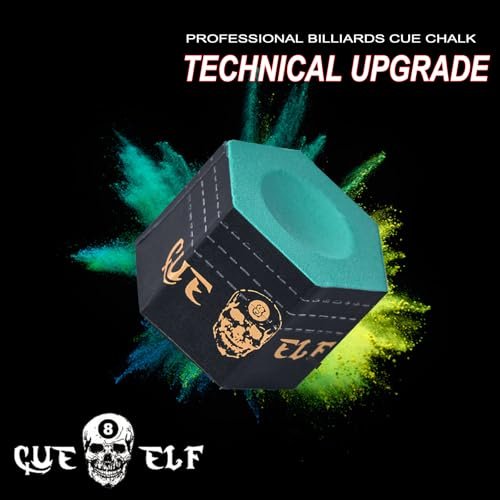
Most players don't think critically about chalk until they start miscuing. Chalk exists to create the friction that lets the tip transfer spin and direction cleanly to the cue ball — without it, even a technically sound stroke skids off-center. The question isn't whether you need chalk; it's whether the chalk you're using is actually staying on the tip through your stroke, or spraying off on contact and leaving you to re-chalk every two shots.
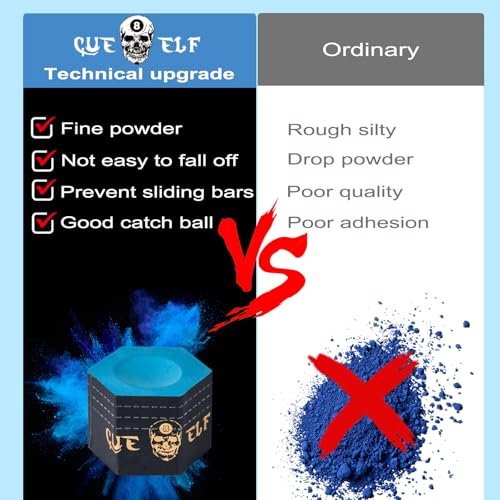
The key variable is grain size and adhesion. Coarser chalk — the kind in most generic blue cubes — applies inconsistently and flakes away more aggressively on impact. Finer-grain chalk like CUEELF's formula applies in a thinner, more even coat and grips the tip surface rather than sitting loosely on top of it. The result is more shots between applications and fewer miscues caused by chalk failure rather than stroke error. That distinction matters when you're trying to diagnose your game: a miscue on a running English shot is either a tip problem, a stroke problem, or a chalk problem. CUEELF chalk removes one variable.
Color choice is more functional than it sounds. Standard blue chalk leaves visible residue on the cue ball — noticeable on slow cloth and a genuine problem on tournament-quality felt. Grey chalk was specifically developed to reduce cue ball marking. Green, pink, purple, and yellow options exist for players who want to identify their chalk at a shared table or simply don't want blue dust on their bridge hand after a long session. None of these color differences affect performance; they're a practical quality-of-life decision.
Hexagon Format vs Standard Cube, and When Each Makes Sense
CUEELF offers two physical formats in this line. The hexagonal chalk (ASIN B0F5WDC49P) has a larger contact surface due to its shape and comes in a package roughly 2.17 × 2.09 × 1.38 inches — noticeably more chalk per piece than the compact cube. The cube format (CHALK-CUBE, B0DZBLRNK9 in pink, B0DZBDXQ9G in yellow) comes in at 1.57 × 1.57 × 0.79 inches, weighing just 2 grams and including a chalk box. It's the pocket-carry option for players who want chalk on them at a bar table or away tournament without adding bulk to a cue bag.
The hexagonal shape of the premium chalk isn't purely cosmetic. A standard cube chalks across two flat faces — you rotate the cube to avoid wearing a groove. The hex profile gives you six face angles to work across, which slows uneven wear and extends the time before you're chasing a creviced cube that only contacts the tip on its edges. For players who chalk heavily and consistently (which you should be), that wear pattern matters over the life of the piece.
- Heavy chalk users, league nights, home table: The hexagonal format gives you more chalk per piece and more usable contact surface over time.
- Travel, bar leagues, tournament carry: The cube format at 2 grams with an included chalk box fits in a jeans pocket or the smallest compartment of any cue bag.
- Color preference: The hexagonal line covers blue, green, pink, purple, and grey. The cube line is currently available in pink and yellow. If grey is your priority — and it should be if you play on quality cloth — go hexagonal.
- Break cue chalking: Regardless of format, apply chalk more heavily before break shots, especially if you're using a Bakelite-tipped break cue. Bakelite is less porous than leather and requires more chalk coverage to prevent miscues on the break.
How to Apply Chalk Correctly and Extend Its Life
Most players chalk wrong. The standard grip-and-spin approach — rotating the chalk cube like you're winding a clock — creates uneven wear and grinds chalk unevenly into the tip. The correct method is consistent light pressure across the tip surface in a deliberate, controlled motion, making sure the entire face of the tip makes contact. You're trying to deposit a thin, even layer of chalk across the tip, not excavate a hole in the center of your cube.

How often you chalk depends on what you're doing. For standard shots with no spin, every two to three shots is reasonable. For heavy side spin (running or reverse English), chalk before every shot — chalk wears faster on off-center contact. Before a break, chalk twice if you're using a leather-tipped playing cue, and more generously if you're using a hard Bakelite tip. One of the most common causes of an opening miscue is insufficient chalk on a tip that hasn't been conditioned during warm-up.
- Don't blow on the tip after chalking. Moisture from breath degrades adhesion. Tap the side of the chalk cube or shaft to knock off excess dust instead.
- Keep chalk dry. Humid environments change chalk consistency. The included chalk box on the cube format helps protect the chalk between sessions, especially if you play in a basement or outdoor covered patio setup where humidity varies.
- Check tip condition first. Chalk performs better on a properly scuffed tip. If your chalk is spraying off on contact rather than sticking, the issue is usually a glazed or mushroomed tip rather than the chalk itself. A scuffing tool restores the texture the tip needs to hold chalk between shots.
- Don't mix chalk brands mid-session. Different chalk formulations have slightly different grain sizes and adhesion profiles. Switching mid-game introduces inconsistency you don't need.
Proper chalk storage is straightforward: keep it in its box when not in use, store it somewhere with stable humidity, and don't leave it loose at the bottom of a bag where it picks up debris. The cube format's included chalk box handles this directly. For the hexagonal chalk, a small chalk holder — like CUEELF's aluminum alloy magnetic chalk holder — keeps it accessible between shots without setting it on the rail where it can pick up table grime.
Frequently Asked Questions
Is CUEELF chalk actually better than Master or Silver Cup, or is it just a different color?
It's a step up from Master in the ways that matter most at the table — finer grain, better tip adhesion, and noticeably less flaking on contact. That means more usable shots between applications and fewer chalk-failure miscues. It's not in the same category as Taom V10 or Kamui Black, which are premium chalk products at a significantly different price point. For a player currently using Master or Silver Cup who wants cleaner performance without moving into the premium chalk tier, CUEELF chalk is the right call. Don't expect a miracle cure for stroke problems, but do expect the chalk variable to stop interfering with your shot results.
Does the color affect how the chalk performs, or is this just cosmetic?
Performance is the same across all colors — the difference is purely practical. Grey chalk is the most functionally useful choice if you play on quality cloth, since it doesn't mark the cue ball the way blue does. Green, pink, purple, and yellow are useful for identifying your chalk on a shared table or avoiding blue residue on your bridge hand. If you play on a bar table with older cloth and don't care about cue ball marking, any color works equally well. If you're playing on tournament-quality felt or at a club where table condition matters, go grey.
What's the difference between the hexagonal chalk and the cube — does the shape matter?
The shape affects wear pattern and how much usable chalk you get over time. A standard cube wears across two flat faces, and you need to rotate it to avoid grinding a groove. The hexagonal format gives you six face angles to work across, which distributes wear more evenly and keeps the contact surface usable longer. The cube format (available in pink and yellow) is smaller — 1.57 × 1.57 × 0.79 inches and just 2 grams — with an included chalk box, making it the better carry option. The hexagonal chalk is larger and better suited for home tables and frequent players who go through chalk quickly.
My first break attempt with a new tip miscued even after chalking — could the chalk be the problem?
Possibly, but the more likely culprit is how much chalk was applied and the condition of the tip. Hard tips — particularly Bakelite break tips — are less porous than leather and require heavier chalk coverage before break shots. A single light application isn't enough. Apply chalk thoroughly, covering the entire tip face, and do it twice before your first break attempt with a new cue or freshly reshaped tip. If the tip surface is glazed or mushroomed, chalk won't adhere properly regardless of the chalk brand — scuffing the tip to restore surface texture is the fix. Once that habit is established, chalk failure on the break becomes rare.
The cube format says it includes a chalk box — what does that mean, and is it useful?
The chalk box is a small holder that keeps the cube contained between uses so it doesn't pick up debris or crumble loose at the bottom of a bag. For a 2-gram chalk piece you're carrying to a bar league or away tournament, it's the difference between chalk that arrives in one piece and chalk that's ground into the lining of your cue case. It's a practical inclusion, not a premium accessory — but it's the reason the cube format is the better travel option versus the hexagonal chalk, which ships without one.
Can I use this chalk on a carbon fiber shaft, or is it only for leather-tipped maple cues?
Chalk works at the tip, not the shaft — the shaft material is irrelevant to chalk performance. What matters is tip material. CUEELF chalk applies to any cue with a leather tip, whether the shaft is Canadian maple, fiberglass, or carbon fiber. If you're using a break cue with a Bakelite tip, see the answer above about heavier chalk application — that applies regardless of shaft construction. The chalk formula is the same across all formats in this line.